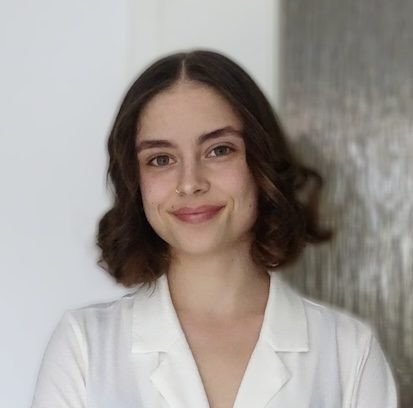
Emely Rosbach
I am a research assistant at the Technical University of Applied Sciences Ingolstadt, where I also received my Master’s degree in User Experience Design. My current research focuses on understanding how medical professionals interact with AI-based decision support systems in digital pathology and radiology. I am particularly interested in how human cognition, specifically cognitive biases, shapes human-machine collaboration in critical environments such as healthcare.
Publications:
2026
Ammeling, Jonas; Ganz, Jonathan; Rosbach, Emely; Lausser, Ludwig; Bertram, Christof A.; Breininger, Katharina; Aubreville, Marc
Benchmarking Foundation Models for Mitotic Figure Classification Journal Article
In: Machine Learning for Biomedical Imaging, vol. 3, no. MELBA–BVM 2025 Special Issue, pp. 38–55, 2026, ISSN: 2766-905X.
Abstract | Links | BibTeX | Tags:
@article{ammeling_benchmarking_2026,
title = {Benchmarking Foundation Models for Mitotic Figure Classification},
author = {Jonas Ammeling and Jonathan Ganz and Emely Rosbach and Ludwig Lausser and Christof A. Bertram and Katharina Breininger and Marc Aubreville},
url = {https://melba-journal.org/2026:003},
doi = {10.59275/j.melba.2026-a3eb},
issn = {2766-905X},
year = {2026},
date = {2026-01-01},
urldate = {2026-02-01},
journal = {Machine Learning for Biomedical Imaging},
volume = {3},
number = {MELBA–BVM 2025 Special Issue},
pages = {38–55},
abstract = {The performance of deep learning models is known to scale with data quantity and diversity. In pathology, as in many other medical imaging domains, the availability of labeled images for a specific task is often limited. Self-supervised learning techniques have enabled the use of vast amounts of unlabeled data to train large-scale neural networks, i.e., foundation models, that can address the limited data problem by providing semantically rich feature vectors that can generalize well to new tasks with minimal training effort increasing model performance and robustness. In this work, we investigate the use of foundation models for mitotic figure classification. The mitotic count, which can be derived from this classification task, is an independent prognostic marker for specific tumors and part of certain tumor grading systems. In particular, we investigate the data scaling laws on multiple current foundation models and evaluate their robustness to unseen tumor domains. Next to the commonly used linear probing paradigm, we also adapt the models using low-rank adaptation (LoRA) of their attention mechanisms. We compare all models against end-to-end-trained baselines, both CNNs and Vision Transformers. Our results demonstrate that LoRA-adapted foundation models provide superior performance to those adapted with standard linear probing, reaching performance levels close to 100 % data availability with only 10 % of training data. Furthermore, LoRA-adaptation of the most recent foundation models almost closes the out-of-domain performance gap when evaluated on unseen tumor domains. However, full fine-tuning of traditional architectures still yields competitive performance.},
keywords = {},
pubstate = {published},
tppubtype = {article}
}
2025
Rosbach, Emely; Ammeling, Jonas; Krügel, Sebastian; Kießig, Angelika; Fritz, Alexis; Ganz, Jonathan; Puget, Chloé; Donovan, Taryn; Klang, Andrea; Köller, Maximilian C.; Bolfa, Pompei; Tecilla, Marco; Denk, Daniela; Kiupel, Matti; Paraschou, Georgios; Kok, Mun Keong; Haake, Alexander F. H.; Krijger, Ronald R. De; Sonnen, Andreas F. -P.; Kasantikul, Tanit; Dorrestein, Gerry M.; Smedley, Rebecca C.; Stathonikos, Nikolas; Uhl, Matthias; Bertram, Christof A.; Riener, Andreas; Aubreville, Marc
“When Two Wrongs Don’t Make a Right” – Examining Confirmation Bias and the Role of Time Pressure During Human-AI Collaboration in Computational Pathology Proceedings Article
In: Proceedings of the 2025 CHI Conference on Human Factors in Computing Systems, pp. 1–18, ACM, Yokohama Japan, 2025, ISBN: 9798400713941.
@inproceedings{rosbach_when_2025,
title = {"When Two Wrongs Don't Make a Right" - Examining Confirmation Bias and the Role of Time Pressure During Human-AI Collaboration in Computational Pathology},
author = {Emely Rosbach and Jonas Ammeling and Sebastian Krügel and Angelika Kießig and Alexis Fritz and Jonathan Ganz and Chloé Puget and Taryn Donovan and Andrea Klang and Maximilian C. Köller and Pompei Bolfa and Marco Tecilla and Daniela Denk and Matti Kiupel and Georgios Paraschou and Mun Keong Kok and Alexander F. H. Haake and Ronald R. De Krijger and Andreas F. -P. Sonnen and Tanit Kasantikul and Gerry M. Dorrestein and Rebecca C. Smedley and Nikolas Stathonikos and Matthias Uhl and Christof A. Bertram and Andreas Riener and Marc Aubreville},
url = {https://dl.acm.org/doi/10.1145/3706598.3713319},
doi = {10.1145/3706598.3713319},
isbn = {9798400713941},
year = {2025},
date = {2025-04-01},
urldate = {2025-04-25},
booktitle = {Proceedings of the 2025 CHI Conference on Human Factors in Computing Systems},
pages = {1–18},
publisher = {ACM},
address = {Yokohama Japan},
keywords = {},
pubstate = {published},
tppubtype = {inproceedings}
}
Rosbach, Emely; Ganz, Jonathan; Ammeling, Jonas; Riener, Andreas; Aubreville, Marc
Automation Bias in AI-assisted Medical Decision-making under Time Pressure in Computational Pathology Book Section
In: Palm, Christoph; Breininger, Katharina; Deserno, Thomas; Handels, Heinz; Maier, Andreas; Maier-Hein, Klaus H.; Tolxdorff, Thomas M. (Ed.): Bildverarbeitung für die Medizin 2025, pp. 129–134, Springer Fachmedien Wiesbaden, Wiesbaden, 2025, ISBN: 978-3-658-47421-8 978-3-658-47422-5.
@incollection{palm_automation_2025,
title = {Automation Bias in AI-assisted Medical Decision-making under Time Pressure in Computational Pathology},
author = {Emely Rosbach and Jonathan Ganz and Jonas Ammeling and Andreas Riener and Marc Aubreville},
editor = {Christoph Palm and Katharina Breininger and Thomas Deserno and Heinz Handels and Andreas Maier and Klaus H. Maier-Hein and Thomas M. Tolxdorff},
url = {https://link.springer.com/10.1007/978-3-658-47422-5_27},
doi = {10.1007/978-3-658-47422-5_27},
isbn = {978-3-658-47421-8 978-3-658-47422-5},
year = {2025},
date = {2025-01-01},
urldate = {2025-03-04},
booktitle = {Bildverarbeitung für die Medizin 2025},
pages = {129–134},
publisher = {Springer Fachmedien Wiesbaden},
address = {Wiesbaden},
keywords = {},
pubstate = {published},
tppubtype = {incollection}
}
Ganz, Jonathan; Ammeling, Jonas; Rosbach, Emely; Lausser, Ludwig; Bertram, Christof A.; Breininger, Katharina; Aubreville, Marc
In: Palm, Christoph; Breininger, Katharina; Deserno, Thomas; Handels, Heinz; Maier, Andreas; Maier-Hein, Klaus H.; Tolxdorff, Thomas M. (Ed.): Bildverarbeitung für die Medizin 2025, pp. 63–68, Springer Fachmedien Wiesbaden, Wiesbaden, 2025, ISBN: 978-3-658-47421-8 978-3-658-47422-5.
@incollection{palm_is_2025,
title = {Is Self-supervision Enough?: Benchmarking Foundation Models Against End-to-end Training for Mitotic Figure Classification},
author = {Jonathan Ganz and Jonas Ammeling and Emely Rosbach and Ludwig Lausser and Christof A. Bertram and Katharina Breininger and Marc Aubreville},
editor = {Christoph Palm and Katharina Breininger and Thomas Deserno and Heinz Handels and Andreas Maier and Klaus H. Maier-Hein and Thomas M. Tolxdorff},
url = {https://link.springer.com/10.1007/978-3-658-47422-5_15},
doi = {10.1007/978-3-658-47422-5_15},
isbn = {978-3-658-47421-8 978-3-658-47422-5},
year = {2025},
date = {2025-01-01},
urldate = {2025-03-04},
booktitle = {Bildverarbeitung für die Medizin 2025},
pages = {63–68},
publisher = {Springer Fachmedien Wiesbaden},
address = {Wiesbaden},
keywords = {},
pubstate = {published},
tppubtype = {incollection}
}
2024
Ganz, Jonathan; Marzahl, Christian; Ammeling, Jonas; Rosbach, Emely; Richter, Barbara; Puget, Chloé; Denk, Daniela; Demeter, Elena A.; Tăbăran, Flaviu A.; Wasinger, Gabriel; Lipnik, Karoline; Tecilla, Marco; Valentine, Matthew J.; Dark, Michael J.; Abele, Niklas; Bolfa, Pompei; Erber, Ramona; Klopfleisch, Robert; Merz, Sophie; Donovan, Taryn A.; Jabari, Samir; Bertram, Christof A.; Breininger, Katharina; Aubreville, Marc
Information mismatch in PHH3-assisted mitosis annotation leads to interpretation shifts in H&E slide analysis Journal Article
In: Scientific Reports, vol. 14, no. 1, pp. 26273, 2024, ISSN: 2045-2322.
Abstract | Links | BibTeX | Tags:
@article{ganz_information_2024,
title = {Information mismatch in PHH3-assisted mitosis annotation leads to interpretation shifts in H&E slide analysis},
author = {Jonathan Ganz and Christian Marzahl and Jonas Ammeling and Emely Rosbach and Barbara Richter and Chloé Puget and Daniela Denk and Elena A. Demeter and Flaviu A. Tăbăran and Gabriel Wasinger and Karoline Lipnik and Marco Tecilla and Matthew J. Valentine and Michael J. Dark and Niklas Abele and Pompei Bolfa and Ramona Erber and Robert Klopfleisch and Sophie Merz and Taryn A. Donovan and Samir Jabari and Christof A. Bertram and Katharina Breininger and Marc Aubreville},
url = {https://www.nature.com/articles/s41598-024-77244-6},
doi = {10.1038/s41598-024-77244-6},
issn = {2045-2322},
year = {2024},
date = {2024-11-01},
urldate = {2024-11-04},
journal = {Scientific Reports},
volume = {14},
number = {1},
pages = {26273},
abstract = {Abstract
The count of mitotic figures (MFs) observed in hematoxylin and eosin (H&E)-stained slides is an important prognostic marker, as it is a measure for tumor cell proliferation. However, the identification of MFs has a known low inter-rater agreement. In a computer-aided setting, deep learning algorithms can help to mitigate this, but they require large amounts of annotated data for training and validation. Furthermore, label noise introduced during the annotation process may impede the algorithms’ performance. Unlike H&E, where identification of MFs is based mainly on morphological features, the mitosis-specific antibody phospho-histone H3 (PHH3) specifically highlights MFs. Counting MFs on slides stained against PHH3 leads to higher agreement among raters and has therefore recently been used as a ground truth for the annotation of MFs in H&E. However, as PHH3 facilitates the recognition of cells indistinguishable from H&E staining alone, the use of this ground truth could potentially introduce an interpretation shift and even label noise into the H&E-related dataset, impacting model performance. This study analyzes the impact of PHH3-assisted MF annotation on inter-rater reliability and object level agreement through an extensive multi-rater experiment. Subsequently, MF detectors, including a novel dual-stain detector, were evaluated on the resulting datasets to investigate the influence of PHH3-assisted labeling on the models’ performance. We found that the annotators’ object-level agreement significantly increased when using PHH3-assisted labeling (F1: 0.53 to 0.74). However, this enhancement in label consistency did not translate to improved performance for H&E-based detectors, neither during the training phase nor the evaluation phase. Conversely, the dual-stain detector was able to benefit from the higher consistency. This reveals an information mismatch between the H&E and PHH3-stained images as the cause of this effect, which renders PHH3-assisted annotations not well-aligned for use with H&E-based detectors. Based on our findings, we propose an improved PHH3-assisted labeling procedure.},
keywords = {},
pubstate = {published},
tppubtype = {article}
}
The count of mitotic figures (MFs) observed in hematoxylin and eosin (H&E)-stained slides is an important prognostic marker, as it is a measure for tumor cell proliferation. However, the identification of MFs has a known low inter-rater agreement. In a computer-aided setting, deep learning algorithms can help to mitigate this, but they require large amounts of annotated data for training and validation. Furthermore, label noise introduced during the annotation process may impede the algorithms’ performance. Unlike H&E, where identification of MFs is based mainly on morphological features, the mitosis-specific antibody phospho-histone H3 (PHH3) specifically highlights MFs. Counting MFs on slides stained against PHH3 leads to higher agreement among raters and has therefore recently been used as a ground truth for the annotation of MFs in H&E. However, as PHH3 facilitates the recognition of cells indistinguishable from H&E staining alone, the use of this ground truth could potentially introduce an interpretation shift and even label noise into the H&E-related dataset, impacting model performance. This study analyzes the impact of PHH3-assisted MF annotation on inter-rater reliability and object level agreement through an extensive multi-rater experiment. Subsequently, MF detectors, including a novel dual-stain detector, were evaluated on the resulting datasets to investigate the influence of PHH3-assisted labeling on the models’ performance. We found that the annotators’ object-level agreement significantly increased when using PHH3-assisted labeling (F1: 0.53 to 0.74). However, this enhancement in label consistency did not translate to improved performance for H&E-based detectors, neither during the training phase nor the evaluation phase. Conversely, the dual-stain detector was able to benefit from the higher consistency. This reveals an information mismatch between the H&E and PHH3-stained images as the cause of this effect, which renders PHH3-assisted annotations not well-aligned for use with H&E-based detectors. Based on our findings, we propose an improved PHH3-assisted labeling procedure.
Aubreville, Marc; Ganz, Jonathan; Ammeling, Jonas; Rosbach, Emely; Gehrke, Thomas; Scherzad, Agmal; Hackenberg, Stephan; Goncalves, Miguel
Prediction of tumor board procedural recommendations using large language models Journal Article
In: European Archives of Oto-Rhino-Laryngology, 2024, ISSN: 1434-4726.
Abstract | Links | BibTeX | Tags:
@article{aubreville_prediction_2024,
title = {Prediction of tumor board procedural recommendations using large language models},
author = {Marc Aubreville and Jonathan Ganz and Jonas Ammeling and Emely Rosbach and Thomas Gehrke and Agmal Scherzad and Stephan Hackenberg and Miguel Goncalves},
url = {https://doi.org/10.1007/s00405-024-08947-9},
doi = {10.1007/s00405-024-08947-9},
issn = {1434-4726},
year = {2024},
date = {2024-09-01},
journal = {European Archives of Oto-Rhino-Laryngology},
abstract = {Multidisciplinary tumor boards are meetings where a team of medical specialists, including medical oncologists, radiation oncologists, radiologists, surgeons, and pathologists, collaborate to determine the best treatment plan for cancer patients. While decision-making in this context is logistically and cost-intensive, it has a significant positive effect on overall cancer survival.},
keywords = {},
pubstate = {published},
tppubtype = {article}
}