
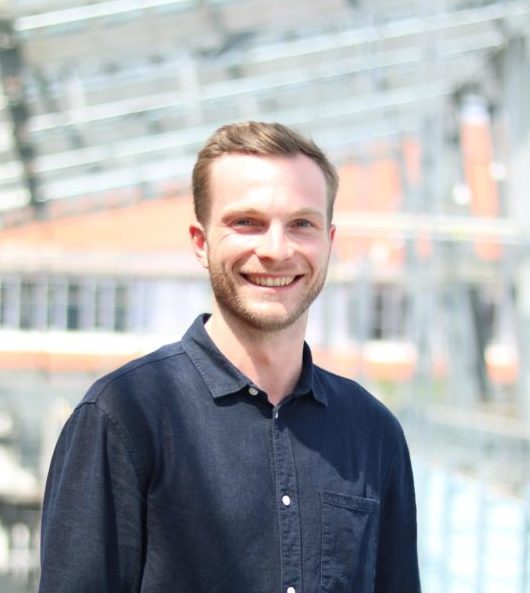
Jonas Ammeling
I am a research assistant and PhD student at the Technical University of Applied Sciences Ingolstadt. I received my Master’s degree in Statistics & Data Science from Leiden University in the Netherlands. My current work focuses on the development of deep learning applications in digital pathology and radiology. I am particularly interested in object detection methods, self-supervised learning, more user-centric approaches, and multimodal vision-language processing.
Publications:
2026
Rosbach, Emely; Ammeling, Jonas; Bertram, Christof A.; Riener, Andreas; Aubreville, Marc
Cognitive biases in AI–assisted medical decision making: A structured review as a primer for veterinary and human pathology Journal Article
In: Veterinary Pathology, pp. 03009858261472493, 2026, ISSN: 0300-9858, 1544-2217.
Abstract | Links | BibTeX | Tags:
@article{rosbach_cognitive_2026,

title = {Cognitive biases in AI–assisted medical decision making: A structured review as a primer for veterinary and human pathology},

author = {Emely Rosbach and Jonas Ammeling and Christof A. Bertram and Andreas Riener and Marc Aubreville},

url = {https://journals.sagepub.com/doi/10.1177/03009858261472493},

doi = {10.1177/03009858261472493},

issn = {0300-9858, 1544-2217},

year  = {2026},

date = {2026-08-01},

urldate = {2026-08-06},

journal = {Veterinary Pathology},

pages = {03009858261472493},

abstract = {Cognitive biases are systematic patterns of error in human thinking. While artificial intelligence (AI)-based decision support systems offer great potential to enhance diagnostic accuracy and efficiency in pathology, collaboration between medical professionals and AI can also introduce or amplify these biases. This review aims to identify cognitive biases and their modes of manifestation in human-computer interaction (HCI) within pathology and to extrapolate potential manifestations of biases not yet explored in this domain but reported in HCIs across other medical specialties. We conducted a structured literature review (19 August 2025) across the ACM, IEEE, and PubMed databases. Studies were eligible if they operationalized cognitive biases during expert–machine interaction in diagnostic decision-making using qualitative or quantitative methods, including review articles citing primary studies that met these criteria. The final corpus comprised 24 studies (8 primary studies and 16 review articles). From these review articles, 18 additional primary studies were extracted and used in their place solely for analysis purposes. A narrative synthesis of the identified primary research revealed 12 cognitive biases reported in AI-assisted medical decision-making, with only one study originating from pathology. For each bias, definitions and hypothetical pathology-specific examples were derived. This review is intended as a primer for the veterinary and human pathology communities and strives to contribute to the safe and effective integration of AI into diagnostic practice.},

keywords = {},

pubstate = {published},

tppubtype = {article}

}
Bertram, Christof A.; Ammeling, Jonas; Bartel, Alexander; Beamer, Gillian; Aubreville, Marc
Performance evaluation of deep learning models for image analysis: Considerations for visual assessment and statistical metrics Journal Article
In: Veterinary Pathology, pp. 03009858261461760, 2026, ISSN: 0300-9858, 1544-2217.
Abstract | Links | BibTeX | Tags:
@article{bertram_performance_2026,

title = {Performance evaluation of deep learning models for image analysis: Considerations for visual assessment and statistical metrics},

author = {Christof A. Bertram and Jonas Ammeling and Alexander Bartel and Gillian Beamer and Marc Aubreville},

url = {https://journals.sagepub.com/doi/10.1177/03009858261461760},

doi = {10.1177/03009858261461760},

issn = {0300-9858, 1544-2217},

year  = {2026},

date = {2026-07-01},

urldate = {2026-07-07},

journal = {Veterinary Pathology},

pages = {03009858261461760},

abstract = {Deep learning-based automated image analysis (DL-AIA) has been shown to outperform trained pathologists in tasks related to feature quantification. Related to these capabilities, the use of DL-AIA tools is currently extending from proof-of-principle studies to routine applications, including the evaluation of patient samples (diagnostic pathology), regulatory safety assessment (toxicologic pathology), and recurrent research tasks. To ensure that DL-AIA applications are safe and reliable, it is critical to conduct a thorough and objective generalization performance assessment to evaluate an algorithm’s ability to accurately predict patterns of interest and possibly evaluate model robustness (ie, the algorithm’s capacity to maintain predictive accuracy on images from different sources). In this article, we review the practices for performance assessment in veterinary pathology publications by which 2 main approaches were identified: (1) exclusive visual performance assessment (ie, eyeballing algorithmic predictions) plus validation of the model’s application utilizing secondary performance indices and (2) statistical performance assessment (alongside other methods), which requires creation of a test set with ground truth labels that is a hold-out from model development. This article compares the strengths and weaknesses of statistical and visual performance assessment methods. Furthermore, we discuss relevant considerations for rigorous statistical performance evaluation including metric selection, test data set image composition, ground truth label quality, resampling methods such as bootstrapping, statistical comparison of multiple models, and evaluation of model stability. It is our conclusion that visual and statistical evaluation have complementary strengths and a combined approach provides the greatest insight into the DL model’s performance and sources of error.},

keywords = {},

pubstate = {published},

tppubtype = {article}

}
Bertram, Christof A.; Weiss, Viktoria; Ammeling, Jonas; Schabel, F. Maria; Donovan, Taryn A.; Wilm, Frauke; Marzahl, Christian; Breininger, Katharina; Aubreville, Marc
Data set creation for supervised deep learning–based analysis of microscopic images: Review of important considerations and recommendations Journal Article
In: Veterinary Pathology, pp. 03009858261457959, 2026, ISSN: 0300-9858, 1544-2217.
Abstract | Links | BibTeX | Tags:
@article{bertram_data_2026,

title = {Data set creation for supervised deep learning–based analysis of microscopic images: Review of important considerations and recommendations},

author = {Christof A. Bertram and Viktoria Weiss and Jonas Ammeling and F. Maria Schabel and Taryn A. Donovan and Frauke Wilm and Christian Marzahl and Katharina Breininger and Marc Aubreville},

url = {https://journals.sagepub.com/doi/10.1177/03009858261457959},

doi = {10.1177/03009858261457959},

issn = {0300-9858, 1544-2217},

year  = {2026},

date = {2026-06-01},

urldate = {2026-06-30},

journal = {Veterinary Pathology},

pages = {03009858261457959},

abstract = {Supervised deep learning (DL) receives great interest for automated analysis of microscopic images with an increasing body of literature supporting its potential. The development and testing of those DL models rely heavily on the availability of high-quality, large-scale data sets. However, creating such data sets is a complex and resource-intensive process, often hindered by challenges such as time constraints, domain variability, and risks of bias in image collection and label creation. This review provides a comprehensive guide to the critical steps in data set creation, including (1) image acquisition, (2) selection of annotation software, and (3) annotation creation. For image acquisition, besides ensuring a sufficiently large number, it is important to address sources of image variability (domain shifts), such as those related to slide preparation and digitization, that could lead to algorithmic errors if not adequately represented in the training data. For annotations, key quality criteria are the 3 “C”s: correctness, consistency, and completeness. For mitigation of annotation bias of a single annotator, this review explores advanced annotation methods (eg, computer-assisted annotations). To support data set creators, a standard operating procedure is provided as supplemental material, summarizing all important considerations for data set creation. Furthermore, this article underscores the importance of open data sets in driving innovation and enhancing reproducibility of DL research. By addressing the challenges and offering practical recommendations, this review aims to advance the creation and availability of high-quality, large-scale data sets, ultimately contributing to the development of generalizable and robust DL models for pathology applications.},

keywords = {},

pubstate = {published},

tppubtype = {article}

}
Banerjee, Sweta; Bertram, Christof A.; Weiss, Viktoria; Ammeling, Jonas; Conrad, Thomas; Porsche, Nils; Klopfleisch, Robert; Stroblberger, Christoph; Kaltenecker, Christopher; Breininger, Katharina; Aubreville, Marc
Reporting transparency in veterinary pathology deep learning: A systematic review of reproducibility-critical details Journal Article
In: Veterinary Pathology, pp. 03009858261459452, 2026, ISSN: 0300-9858, 1544-2217.
Abstract | Links | BibTeX | Tags:
@article{banerjee_reporting_2026,

title = {Reporting transparency in veterinary pathology deep learning: A systematic review of reproducibility-critical details},

author = {Sweta Banerjee and Christof A. Bertram and Viktoria Weiss and Jonas Ammeling and Thomas Conrad and Nils Porsche and Robert Klopfleisch and Christoph Stroblberger and Christopher Kaltenecker and Katharina Breininger and Marc Aubreville},

url = {https://journals.sagepub.com/doi/10.1177/03009858261459452},

doi = {10.1177/03009858261459452},

issn = {0300-9858, 1544-2217},

year  = {2026},

date = {2026-06-01},

urldate = {2026-06-30},

journal = {Veterinary Pathology},

pages = {03009858261459452},

abstract = {Whereas reproducibility of studies is a prerequisite for trustworthy deep learning (DL) in veterinary histopathology and microscopy, the actual degree of methodological transparency that exists in the literature remains uncertain. We performed a Preferred Reporting Items for Systematic Reviews and Meta-Analyses-guided systematic review to quantify the degree to which supervised DL and supervised machine learning studies report reproducibility-critical details. Using a veterinary-journal-restricted Boolean search executed in PubMed and Scopus, we screened 180 unique records and included 50 primary research articles for full-text analysis. Based on a recently published guideline for the development of DL models in veterinary pathology, we extracted information for each study across 5 dimensions: (1) study and task characterization, (2) data transparency, (3) experimental design and data-leakage control, (4) model and training details, and (5) performance evaluation and reporting. Among the included studies, private data sets predominated, with 90% of studies relying on private data. Sharing of code was uncommon (3%). Key training details such as augmentation and hyperparameters were often incompletely reported; augmentation was not reported in 56% of studies, and key hyperparameters were absent in 40% of studies. It was often not clear whether patient-level stratification (necessary to avoid data leakage) was performed. In summary, these results highlight major deficits in the reporting of details and experimental design necessary for reproducing DL results in veterinary histopathology. This review provides a practical baseline and reporting roadmap to support more transparent and reproducible research in veterinary computational pathology.},

keywords = {},

pubstate = {published},

tppubtype = {article}

}
Rosbach, Emely; Ammeling, Jonas; Ganz, Jonathan; Bertram, Christof A.; Conrad, Thomas; Riener, Andreas; Aubreville, Marc
Stuck on Suggestions: Automation Bias, the Anchoring Effect, and the Factors That Shape Them in Computational Pathology Journal Article
In: Machine Learning for Biomedical Imaging, vol. 3, no. MELBA–BVM 2025 Special Issue, pp. 126–147, 2026.
@article{rosbach_stuck_2026,

title = {Stuck on Suggestions: Automation Bias, the Anchoring Effect, and the Factors That Shape Them in Computational Pathology},

author = {Emely Rosbach and Jonas Ammeling and Jonathan Ganz and Christof A. Bertram and Thomas Conrad and Andreas Riener and Marc Aubreville},

doi = {https://doi.org/10.59275/j.melba.2026-87b1},

year  = {2026},

date = {2026-03-01},

journal = {Machine Learning for Biomedical Imaging},

volume = {3},

number = {MELBA–BVM 2025 Special Issue},

pages = {126–147},

keywords = {},

pubstate = {published},

tppubtype = {article}

}
Ivan, Zsanett Zsofia; Hirling, Dominik; Grexa, Istvan; Ammeling, Jonas; Molnar, Csaba; Micsik, Tamas; Dobra, Katalin; Kuthi, Levente; Sukosd, Farkas; Fillinger, Janos; Moldvay, Judit; Toth, Erika; Aubreville, Marc; Miczan, Vivien; Horvath, Peter
A Subphase-Labeled Mitotic Dataset for AI-powered Cell Division Analysis Journal Article
In: Scientific Data, 2026, ISSN: 2052-4463.
Abstract | Links | BibTeX | Tags:
@article{ivan_subphase-labeled_2026,

title = {A Subphase-Labeled Mitotic Dataset for AI-powered Cell Division Analysis},

author = {Zsanett Zsofia Ivan and Dominik Hirling and Istvan Grexa and Jonas Ammeling and Csaba Molnar and Tamas Micsik and Katalin Dobra and Levente Kuthi and Farkas Sukosd and Janos Fillinger and Judit Moldvay and Erika Toth and Marc Aubreville and Vivien Miczan and Peter Horvath},

url = {https://www.nature.com/articles/s41597-026-07007-7},

doi = {10.1038/s41597-026-07007-7},

issn = {2052-4463},

year  = {2026},

date = {2026-03-01},

urldate = {2026-03-21},

journal = {Scientific Data},

abstract = {Abstract

 Mitosis detection represents a critical task in digital pathology, as it plays an important role in the tumor grading and prognosis of patients. Manual determination is a labor-intensive task for practitioners with high interobserver variability, thus, automation is a priority. There has been substantial progress towards creating robust mitosis detection algorithms, primarily driven by the Mitosis Domain Generalization (MIDOG) challenges. Also, there has been growing interest in the molecular characterization of mitosis to achieve a more comprehensive understanding of its underlying mechanisms in a subphase-specific manner. We introduce a new mitotic figure dataset annotated with subphase information based on the MIDOG++ dataset as well as a previously unrepresented tumor domain to enhance the diversity and applicability. We envision a new perspective for domain generalization by improving model performance with subtyping mitosis, complemented with an atypical mitotic class. Our work has implications in two main areas: subtyping information can provide helpful information in mitosis detection, while also providing promising new directions in answering biological questions, such as molecular analysis of subphases.},

keywords = {},

pubstate = {published},

tppubtype = {article}

}
Mitosis detection represents a critical task in digital pathology, as it plays an important role in the tumor grading and prognosis of patients. Manual determination is a labor-intensive task for practitioners with high interobserver variability, thus, automation is a priority. There has been substantial progress towards creating robust mitosis detection algorithms, primarily driven by the Mitosis Domain Generalization (MIDOG) challenges. Also, there has been growing interest in the molecular characterization of mitosis to achieve a more comprehensive understanding of its underlying mechanisms in a subphase-specific manner. We introduce a new mitotic figure dataset annotated with subphase information based on the MIDOG++ dataset as well as a previously unrepresented tumor domain to enhance the diversity and applicability. We envision a new perspective for domain generalization by improving model performance with subtyping mitosis, complemented with an atypical mitotic class. Our work has implications in two main areas: subtyping information can provide helpful information in mitosis detection, while also providing promising new directions in answering biological questions, such as molecular analysis of subphases.
Ammeling, Jonas; Ganz, Jonathan; Rosbach, Emely; Lausser, Ludwig; Bertram, Christof A.; Breininger, Katharina; Aubreville, Marc
Benchmarking Foundation Models for Mitotic Figure Classification Journal Article
In: Machine Learning for Biomedical Imaging, vol. 3, no. MELBA–BVM 2025 Special Issue, pp. 38–55, 2026, ISSN: 2766-905X.
Abstract | Links | BibTeX | Tags:
@article{ammeling_benchmarking_2026,

title = {Benchmarking Foundation Models for Mitotic Figure Classification},

author = {Jonas Ammeling and Jonathan Ganz and Emely Rosbach and Ludwig Lausser and Christof A. Bertram and Katharina Breininger and Marc Aubreville},

url = {https://melba-journal.org/2026:003},

doi = {10.59275/j.melba.2026-a3eb},

issn = {2766-905X},

year  = {2026},

date = {2026-01-01},

urldate = {2026-02-01},

journal = {Machine Learning for Biomedical Imaging},

volume = {3},

number = {MELBA–BVM 2025 Special Issue},

pages = {38–55},

abstract = {The performance of deep learning models is known to scale with data quantity and diversity. In pathology, as in many other medical imaging domains, the availability of labeled images for a specific task is often limited. Self-supervised learning techniques have enabled the use of vast amounts of unlabeled data to train large-scale neural networks, i.e., foundation models, that can address the limited data problem by providing semantically rich feature vectors that can generalize well to new tasks with minimal training effort increasing model performance and robustness. In this work, we investigate the use of foundation models for mitotic figure classification. The mitotic count, which can be derived from this classification task, is an independent prognostic marker for specific tumors and part of certain tumor grading systems. In particular, we investigate the data scaling laws on multiple current foundation models and evaluate their robustness to unseen tumor domains. Next to the commonly used linear probing paradigm, we also adapt the models using low-rank adaptation (LoRA) of their attention mechanisms. We compare all models against end-to-end-trained baselines, both CNNs and Vision Transformers. Our results demonstrate that LoRA-adapted foundation models provide superior performance to those adapted with standard linear probing, reaching performance levels close to 100 % data availability with only 10 % of training data. Furthermore, LoRA-adaptation of the most recent foundation models almost closes the out-of-domain performance gap when evaluated on unseen tumor domains. However, full fine-tuning of traditional architectures still yields competitive performance.},

keywords = {},

pubstate = {published},

tppubtype = {article}

}
Banerjee, Sweta; Weiss, Viktoria; Donovan, Taryn A.; Fick, Rutger H. J.; Conrad, Thomas; Ammeling, Jonas; Porsche, Nils; Klopfleisch, Robert; Kaltenecker, Christopher; Breininger, Katharina; Aubreville, Marc; Bertram, Christof A
Benchmarking Deep Learning and Vision Foundation Models for Atypical vs. Normal Mitosis Classification with Cross-Dataset Evaluation Journal Article
In: Machine Learning for Biomedical Imaging, no. MELBA–BVM 2025 Special Issue, pp. 115–125, 2026.
@article{banerjee_benchmarking_2026,

title = {Benchmarking Deep Learning and Vision Foundation Models for Atypical vs. Normal Mitosis Classification with Cross-Dataset Evaluation},

author = {Sweta Banerjee and Viktoria Weiss and Taryn A. Donovan and Rutger H. J. Fick and Thomas Conrad and Jonas Ammeling and Nils Porsche and Robert Klopfleisch and Christopher Kaltenecker and Katharina Breininger and Marc Aubreville and Christof A Bertram},

doi = {https://doi.org/10.59275/j.melba.2026-6c1g},

year  = {2026},

date = {2026-01-01},

journal = {Machine Learning for Biomedical Imaging},

number = {MELBA–BVM 2025 Special Issue},

pages = {115–125},

keywords = {},

pubstate = {published},

tppubtype = {article}

}
Banerjee, Sweta; Gosch, Timo; Hester, Sara; Weiss, Viktoria; Conrad, Thomas; Donovan, Taryn A.; Porsche, Nils; Ammeling, Jonas; Stroblberger, Christoph; Klopfleisch, Robert; Kaltenecker, Christopher; Bertram, Christof A.; Breininger, Katharina; Aubreville, Marc
Enabling Fast and Mobile Histopathology Image Annotation through Swipeable Interfaces SWAN Book Section
In: Handels, Heinz; Breininger, Katharina; Deserno, Thomas; Maier, Andreas; Maier-Hein, Klaus; Palm, Christoph; Tolxdorff, Thomas (Ed.): Bildverarbeitung für die Medizin 2026, pp. 203–209, Springer Fachmedien Wiesbaden, Wiesbaden, 2026, ISBN: 978-3-658-51099-2 978-3-658-51100-5, (Series Title: Informatik aktuell).
@incollection{handels_enabling_2026,

title = {Enabling Fast and Mobile Histopathology Image Annotation through Swipeable Interfaces SWAN},

author = {Sweta Banerjee and Timo Gosch and Sara Hester and Viktoria Weiss and Thomas Conrad and Taryn A. Donovan and Nils Porsche and Jonas Ammeling and Christoph Stroblberger and Robert Klopfleisch and Christopher Kaltenecker and Christof A. Bertram and Katharina Breininger and Marc Aubreville},

editor = {Heinz Handels and Katharina Breininger and Thomas Deserno and Andreas Maier and Klaus Maier-Hein and Christoph Palm and Thomas Tolxdorff},

url = {https://link.springer.com/10.1007/978-3-658-51100-5_42},

doi = {10.1007/978-3-658-51100-5_42},

isbn = {978-3-658-51099-2 978-3-658-51100-5},

year  = {2026},

date = {2026-01-01},

urldate = {2026-03-12},

booktitle = {Bildverarbeitung für die Medizin 2026},

pages = {203–209},

publisher = {Springer Fachmedien Wiesbaden},

address = {Wiesbaden},

note = {Series Title: Informatik aktuell},

keywords = {},

pubstate = {published},

tppubtype = {incollection}

}
Ammeling, Jonas; Ganz, Jonathan; Wilm, Frauke; Breininger, Katharina; Aubreville, Marc
Abstract: Investigation of Class Separability within Object Detection Models in Histopathology Book Section
In: Handels, Heinz; Breininger, Katharina; Deserno, Thomas; Maier, Andreas; Maier-Hein, Klaus; Palm, Christoph; Tolxdorff, Thomas (Ed.): Bildverarbeitung für die Medizin 2026, pp. 18–18, Springer Fachmedien Wiesbaden, Wiesbaden, 2026, ISBN: 978-3-658-51099-2 978-3-658-51100-5, (Series Title: Informatik aktuell).
@incollection{handels_abstract_2026,

title = {Abstract: Investigation of Class Separability within Object Detection Models in Histopathology},

author = {Jonas Ammeling and Jonathan Ganz and Frauke Wilm and Katharina Breininger and Marc Aubreville},

editor = {Heinz Handels and Katharina Breininger and Thomas Deserno and Andreas Maier and Klaus Maier-Hein and Christoph Palm and Thomas Tolxdorff},

url = {https://link.springer.com/10.1007/978-3-658-51100-5_3},

doi = {10.1007/978-3-658-51100-5_3},

isbn = {978-3-658-51099-2 978-3-658-51100-5},

year  = {2026},

date = {2026-01-01},

urldate = {2026-03-12},

booktitle = {Bildverarbeitung für die Medizin 2026},

pages = {18–18},

publisher = {Springer Fachmedien Wiesbaden},

address = {Wiesbaden},

note = {Series Title: Informatik aktuell},

keywords = {},

pubstate = {published},

tppubtype = {incollection}

}
Banerjee, Sweta; Ammeling, Jonas; Weiss, Viktoria; Donovan, Taryn A.; Klopfleisch, Robert; Bertram, Christof A.; Breininger, Katharina; Aubreville, Marc
Mitosis Domain Generalization (MIDOG) Challenge 2025 Baselines Book Section
In: Aubreville, Marc; Bertram, Christof A. (Ed.): Mitotic Figure Detection and Atypia Classification in Whole Slide Images, vol. 16519, pp. 1–11, Springer Nature Switzerland, Cham, 2026, ISBN: 9783032251794 9783032251800.
@incollection{aubreville_mitosis_2026,

title = {Mitosis Domain Generalization (MIDOG) Challenge 2025 Baselines},

author = {Sweta Banerjee and Jonas Ammeling and Viktoria Weiss and Taryn A. Donovan and Robert Klopfleisch and Christof A. Bertram and Katharina Breininger and Marc Aubreville},

editor = {Marc Aubreville and Christof A. Bertram},

url = {https://link.springer.com/10.1007/978-3-032-25180-0_1},

doi = {10.1007/978-3-032-25180-0_1},

isbn = {9783032251794 9783032251800},

year  = {2026},

date = {2026-01-01},

urldate = {2026-08-09},

booktitle = {Mitotic Figure Detection and Atypia Classification in Whole Slide Images},

volume = {16519},

pages = {1–11},

publisher = {Springer Nature Switzerland},

address = {Cham},

keywords = {},

pubstate = {published},

tppubtype = {incollection}

}
2025
Ammeling, Jonas; Ganz, Jonathan; Wilm, Frauke; Breininger, Katharina; Aubreville, Marc
Investigation of Class Separability within Object Detection Models in Histopathology Journal Article
In: IEEE Transactions on Medical Imaging, vol. 44, no. 8, pp. 3162–3174, 2025, ISSN: 0278-0062, 1558-254X.
@article{ammeling_investigation_2025,

title = {Investigation of Class Separability within Object Detection Models in Histopathology},

author = {Jonas Ammeling and Jonathan Ganz and Frauke Wilm and Katharina Breininger and Marc Aubreville},

url = {https://ieeexplore.ieee.org/document/10965484/},

doi = {10.1109/TMI.2025.3560134},

issn = {0278-0062, 1558-254X},

year  = {2025},

date = {2025-08-01},

urldate = {2025-04-16},

journal = {IEEE Transactions on Medical Imaging},

volume = {44},

number = {8},

pages = {3162–3174},

keywords = {},

pubstate = {published},

tppubtype = {article}

}
Ammeling, Jonas; Aubreville, Marc; Fritz, Alexis; Kießig, Angelika; Krügel, Sebastian; Uhl, Matthias
An interdisciplinary perspective on AI-supported decision making in medicine Journal Article
In: Technology in Society, vol. 81, pp. 102791, 2025, ISSN: 0160791X.
@article{ammeling_interdisciplinary_2025,

title = {An interdisciplinary perspective on AI-supported decision making in medicine},

author = {Jonas Ammeling and Marc Aubreville and Alexis Fritz and Angelika Kießig and Sebastian Krügel and Matthias Uhl},

url = {https://linkinghub.elsevier.com/retrieve/pii/S0160791X24003397},

doi = {10.1016/j.techsoc.2024.102791},

issn = {0160791X},

year  = {2025},

date = {2025-06-01},

urldate = {2024-12-08},

journal = {Technology in Society},

volume = {81},

pages = {102791},

keywords = {},

pubstate = {published},

tppubtype = {article}

}
Rosbach, Emely; Ammeling, Jonas; Krügel, Sebastian; Kießig, Angelika; Fritz, Alexis; Ganz, Jonathan; Puget, Chloé; Donovan, Taryn; Klang, Andrea; Köller, Maximilian C.; Bolfa, Pompei; Tecilla, Marco; Denk, Daniela; Kiupel, Matti; Paraschou, Georgios; Kok, Mun Keong; Haake, Alexander F. H.; Krijger, Ronald R. De; Sonnen, Andreas F. -P.; Kasantikul, Tanit; Dorrestein, Gerry M.; Smedley, Rebecca C.; Stathonikos, Nikolas; Uhl, Matthias; Bertram, Christof A.; Riener, Andreas; Aubreville, Marc
“When Two Wrongs Don’t Make a Right” – Examining Confirmation Bias and the Role of Time Pressure During Human-AI Collaboration in Computational Pathology Proceedings Article
In: Proceedings of the 2025 CHI Conference on Human Factors in Computing Systems, pp. 1–18, ACM, Yokohama Japan, 2025, ISBN: 9798400713941.
@inproceedings{rosbach_when_2025,

title = {"When Two Wrongs Don't Make a Right" - Examining Confirmation Bias and the Role of Time Pressure During Human-AI Collaboration in Computational Pathology},

author = {Emely Rosbach and Jonas Ammeling and Sebastian Krügel and Angelika Kießig and Alexis Fritz and Jonathan Ganz and Chloé Puget and Taryn Donovan and Andrea Klang and Maximilian C. Köller and Pompei Bolfa and Marco Tecilla and Daniela Denk and Matti Kiupel and Georgios Paraschou and Mun Keong Kok and Alexander F. H. Haake and Ronald R. De Krijger and Andreas F. -P. Sonnen and Tanit Kasantikul and Gerry M. Dorrestein and Rebecca C. Smedley and Nikolas Stathonikos and Matthias Uhl and Christof A. Bertram and Andreas Riener and Marc Aubreville},

url = {https://dl.acm.org/doi/10.1145/3706598.3713319},

doi = {10.1145/3706598.3713319},

isbn = {9798400713941},

year  = {2025},

date = {2025-04-01},

urldate = {2025-04-25},

booktitle = {Proceedings of the 2025 CHI Conference on Human Factors in Computing Systems},

pages = {1–18},

publisher = {ACM},

address = {Yokohama Japan},

keywords = {},

pubstate = {published},

tppubtype = {inproceedings}

}
Ammeling, Jonas; Aubreville, Marc; Banerjee, Sweta; Bertram, Christof A.; Breininger, Katharina; Hirling, Dominik; Horvath, Peter; Stathonikos, Nikolas; Veta, Mitko
Mitosis Domain Generalization Challenge 2025 Proceedings Article
In: Zenodo, 2025.
@inproceedings{ammeling_mitosis_2025,

title = {Mitosis Domain Generalization Challenge 2025},

author = {Jonas Ammeling and Marc Aubreville and Sweta Banerjee and Christof A. Bertram and Katharina Breininger and Dominik Hirling and Peter Horvath and Nikolas Stathonikos and Mitko Veta},

url = {https://doi.org/10.5281/zenodo.15077361},

doi = {10.5281/zenodo.15077361},

year  = {2025},

date = {2025-03-01},

publisher = {Zenodo},

keywords = {},

pubstate = {published},

tppubtype = {inproceedings}

}
Qiu, Jingna; Jain, Nishanth; Ammeling, Jonas; Aubreville, Marc; Breininger, Katharina
Effortless Vision-Language Model Specialization in Histopathology without Annotation Proceedings Article
In: MICCAI Workshop on Computational Pathology with Multimodal Data (COMPAYL), 2025.
@inproceedings{qiu_effortless_2025,

title = {Effortless Vision-Language Model Specialization in Histopathology without Annotation},

author = {Jingna Qiu and Nishanth Jain and Jonas Ammeling and Marc Aubreville and Katharina Breininger},

url = {https://openreview.net/forum?id=pQDzXVeBja},

year  = {2025},

date = {2025-01-01},

booktitle = {MICCAI Workshop on Computational Pathology with Multimodal Data (COMPAYL)},

keywords = {},

pubstate = {published},

tppubtype = {inproceedings}

}
Rosbach, Emely; Ganz, Jonathan; Ammeling, Jonas; Riener, Andreas; Aubreville, Marc
Automation Bias in AI-assisted Medical Decision-making under Time Pressure in Computational Pathology Book Section
In: Palm, Christoph; Breininger, Katharina; Deserno, Thomas; Handels, Heinz; Maier, Andreas; Maier-Hein, Klaus H.; Tolxdorff, Thomas M. (Ed.): Bildverarbeitung für die Medizin 2025, pp. 129–134, Springer Fachmedien Wiesbaden, Wiesbaden, 2025, ISBN: 978-3-658-47421-8 978-3-658-47422-5.
@incollection{palm_automation_2025,

title = {Automation Bias in AI-assisted Medical Decision-making under Time Pressure in Computational Pathology},

author = {Emely Rosbach and Jonathan Ganz and Jonas Ammeling and Andreas Riener and Marc Aubreville},

editor = {Christoph Palm and Katharina Breininger and Thomas Deserno and Heinz Handels and Andreas Maier and Klaus H. Maier-Hein and Thomas M. Tolxdorff},

url = {https://link.springer.com/10.1007/978-3-658-47422-5_27},

doi = {10.1007/978-3-658-47422-5_27},

isbn = {978-3-658-47421-8 978-3-658-47422-5},

year  = {2025},

date = {2025-01-01},

urldate = {2025-03-04},

booktitle = {Bildverarbeitung für die Medizin 2025},

pages = {129–134},

publisher = {Springer Fachmedien Wiesbaden},

address = {Wiesbaden},

keywords = {},

pubstate = {published},

tppubtype = {incollection}

}
Ganz, Jonathan; Ammeling, Jonas; Rosbach, Emely; Lausser, Ludwig; Bertram, Christof A.; Breininger, Katharina; Aubreville, Marc
In: Palm, Christoph; Breininger, Katharina; Deserno, Thomas; Handels, Heinz; Maier, Andreas; Maier-Hein, Klaus H.; Tolxdorff, Thomas M. (Ed.): Bildverarbeitung für die Medizin 2025, pp. 63–68, Springer Fachmedien Wiesbaden, Wiesbaden, 2025, ISBN: 978-3-658-47421-8 978-3-658-47422-5.
@incollection{palm_is_2025,

title = {Is Self-supervision Enough?: Benchmarking Foundation Models Against End-to-end Training for Mitotic Figure Classification},

author = {Jonathan Ganz and Jonas Ammeling and Emely Rosbach and Ludwig Lausser and Christof A. Bertram and Katharina Breininger and Marc Aubreville},

editor = {Christoph Palm and Katharina Breininger and Thomas Deserno and Heinz Handels and Andreas Maier and Klaus H. Maier-Hein and Thomas M. Tolxdorff},

url = {https://link.springer.com/10.1007/978-3-658-47422-5_15},

doi = {10.1007/978-3-658-47422-5_15},

isbn = {978-3-658-47421-8 978-3-658-47422-5},

year  = {2025},

date = {2025-01-01},

urldate = {2025-03-04},

booktitle = {Bildverarbeitung für die Medizin 2025},

pages = {63–68},

publisher = {Springer Fachmedien Wiesbaden},

address = {Wiesbaden},

keywords = {},

pubstate = {published},

tppubtype = {incollection}

}
Bertram, Christof A.; Weiss, Viktoria; Donovan, Taryn A.; Banerjee, Sweta; Conrad, Thomas; Ammeling, Jonas; Klopfleisch, Robert; Kaltenecker, Christopher; Aubreville, Marc
Histologic Dataset of Normal and Atypical Mitotic Figures on Human Breast Cancer (AMi-Br) Book Section
In: Palm, Christoph; Breininger, Katharina; Deserno, Thomas; Handels, Heinz; Maier, Andreas; Maier-Hein, Klaus H.; Tolxdorff, Thomas M. (Ed.): Bildverarbeitung für die Medizin 2025, pp. 113–118, Springer Fachmedien Wiesbaden, Wiesbaden, 2025, ISBN: 978-3-658-47421-8 978-3-658-47422-5.
@incollection{palm_histologic_2025,

title = {Histologic Dataset of Normal and Atypical Mitotic Figures on Human Breast Cancer (AMi-Br)},

author = {Christof A. Bertram and Viktoria Weiss and Taryn A. Donovan and Sweta Banerjee and Thomas Conrad and Jonas Ammeling and Robert Klopfleisch and Christopher Kaltenecker and Marc Aubreville},

editor = {Christoph Palm and Katharina Breininger and Thomas Deserno and Heinz Handels and Andreas Maier and Klaus H. Maier-Hein and Thomas M. Tolxdorff},

url = {https://link.springer.com/10.1007/978-3-658-47422-5_25},

doi = {10.1007/978-3-658-47422-5_25},

isbn = {978-3-658-47421-8 978-3-658-47422-5},

year  = {2025},

date = {2025-01-01},

urldate = {2025-03-04},

booktitle = {Bildverarbeitung für die Medizin 2025},

pages = {113–118},

publisher = {Springer Fachmedien Wiesbaden},

address = {Wiesbaden},

keywords = {},

pubstate = {published},

tppubtype = {incollection}

}
Banerjee, Sweta; Bertram, Christof A.; Ammeling, Jonas; Weiss, Viktoria; Conrad, Thomas; Klopfleisch, Robert; Kaltenecker, Christopher; Breininger, Katharina; Aubreville, Marc
Comprehensive Dataset of Coarse Tumor Annotations for The Cancer Genome Atlas Breast Invasive Carcinoma Book Section
In: Palm, Christoph; Breininger, Katharina; Deserno, Thomas; Handels, Heinz; Maier, Andreas; Maier-Hein, Klaus H.; Tolxdorff, Thomas M. (Ed.): Bildverarbeitung für die Medizin 2025, pp. 260–265, Springer Fachmedien Wiesbaden, Wiesbaden, 2025, ISBN: 978-3-658-47421-8 978-3-658-47422-5.
@incollection{palm_comprehensive_2025,

title = {Comprehensive Dataset of Coarse Tumor Annotations for The Cancer Genome Atlas Breast Invasive Carcinoma},

author = {Sweta Banerjee and Christof A. Bertram and Jonas Ammeling and Viktoria Weiss and Thomas Conrad and Robert Klopfleisch and Christopher Kaltenecker and Katharina Breininger and Marc Aubreville},

editor = {Christoph Palm and Katharina Breininger and Thomas Deserno and Heinz Handels and Andreas Maier and Klaus H. Maier-Hein and Thomas M. Tolxdorff},

url = {https://link.springer.com/10.1007/978-3-658-47422-5_56},

doi = {10.1007/978-3-658-47422-5_56},

isbn = {978-3-658-47421-8 978-3-658-47422-5},

year  = {2025},

date = {2025-01-01},

urldate = {2025-03-04},

booktitle = {Bildverarbeitung für die Medizin 2025},

pages = {260–265},

publisher = {Springer Fachmedien Wiesbaden},

address = {Wiesbaden},

keywords = {},

pubstate = {published},

tppubtype = {incollection}

}
Banerjee, Sweta; Weiss, Viktoria; Conrad, Thomas; Donovan, Taryn A.; Ammeling, Jonas; Fick, Rutger H. J.; Utz, Jonas; Klopfleisch, Robert; Kaltenecker, Christopher; Bertram, Christof; Breininger, Katharina; Aubreville, Marc
Chromosome Mask-Conditioned Generative Inpainting for Atypical Mitosis Classification Proceedings Article
In: MICCAI Workshop on Computational Pathology with Multimodal Data (COMPAYL), pp. 266–277, PMLR, 2025.
@inproceedings{banerjee_chromosome_2025,

title = {Chromosome Mask-Conditioned Generative Inpainting for Atypical Mitosis Classification},

author = {Sweta Banerjee and Viktoria Weiss and Thomas Conrad and Taryn A. Donovan and Jonas Ammeling and Rutger H. J. Fick and Jonas Utz and Robert Klopfleisch and Christopher Kaltenecker and Christof Bertram and Katharina Breininger and Marc Aubreville},

url = {https://openreview.net/forum?id=cbQ4fL2Wap},

year  = {2025},

date = {2025-01-01},

booktitle = {MICCAI Workshop on Computational Pathology with Multimodal Data (COMPAYL)},

volume = {316},

pages = {266–277},

publisher = {PMLR},

keywords = {},

pubstate = {published},

tppubtype = {inproceedings}

}
2024
Ammeling, Jonas; Aubreville, Marc; Fritz, Alexis; Kießig, Angelika; Krügel, Sebastian; Uhl, Matthias
An Interdisciplinary Perspective on AI-Supported Decision Making in Medicine Journal Article
In: Technology in Society, pp. 102791, 2024, ISSN: 0160791X.
@article{ammeling_interdisciplinary_2024,

title = {An Interdisciplinary Perspective on AI-Supported Decision Making in Medicine},

author = {Jonas Ammeling and Marc Aubreville and Alexis Fritz and Angelika Kießig and Sebastian Krügel and Matthias Uhl},

url = {https://linkinghub.elsevier.com/retrieve/pii/S0160791X24003397},

doi = {10.1016/j.techsoc.2024.102791},

issn = {0160791X},

year  = {2024},

date = {2024-12-01},

urldate = {2024-12-06},

journal = {Technology in Society},

pages = {102791},

keywords = {},

pubstate = {published},

tppubtype = {article}

}
Ganz, Jonathan; Marzahl, Christian; Ammeling, Jonas; Rosbach, Emely; Richter, Barbara; Puget, Chloé; Denk, Daniela; Demeter, Elena A.; Tăbăran, Flaviu A.; Wasinger, Gabriel; Lipnik, Karoline; Tecilla, Marco; Valentine, Matthew J.; Dark, Michael J.; Abele, Niklas; Bolfa, Pompei; Erber, Ramona; Klopfleisch, Robert; Merz, Sophie; Donovan, Taryn A.; Jabari, Samir; Bertram, Christof A.; Breininger, Katharina; Aubreville, Marc
Information mismatch in PHH3-assisted mitosis annotation leads to interpretation shifts in H&E slide analysis Journal Article
In: Scientific Reports, vol. 14, no. 1, pp. 26273, 2024, ISSN: 2045-2322.
Abstract | Links | BibTeX | Tags:
@article{ganz_information_2024,

title = {Information mismatch in PHH3-assisted mitosis annotation leads to interpretation shifts in H&E slide analysis},

author = {Jonathan Ganz and Christian Marzahl and Jonas Ammeling and Emely Rosbach and Barbara Richter and Chloé Puget and Daniela Denk and Elena A. Demeter and Flaviu A. Tăbăran and Gabriel Wasinger and Karoline Lipnik and Marco Tecilla and Matthew J. Valentine and Michael J. Dark and Niklas Abele and Pompei Bolfa and Ramona Erber and Robert Klopfleisch and Sophie Merz and Taryn A. Donovan and Samir Jabari and Christof A. Bertram and Katharina Breininger and Marc Aubreville},

url = {https://www.nature.com/articles/s41598-024-77244-6},

doi = {10.1038/s41598-024-77244-6},

issn = {2045-2322},

year  = {2024},

date = {2024-11-01},

urldate = {2024-11-04},

journal = {Scientific Reports},

volume = {14},

number = {1},

pages = {26273},

abstract = {Abstract

 The count of mitotic figures (MFs) observed in hematoxylin and eosin (H&E)-stained slides is an important prognostic marker, as it is a measure for tumor cell proliferation. However, the identification of MFs has a known low inter-rater agreement. In a computer-aided setting, deep learning algorithms can help to mitigate this, but they require large amounts of annotated data for training and validation. Furthermore, label noise introduced during the annotation process may impede the algorithms’ performance. Unlike H&E, where identification of MFs is based mainly on morphological features, the mitosis-specific antibody phospho-histone H3 (PHH3) specifically highlights MFs. Counting MFs on slides stained against PHH3 leads to higher agreement among raters and has therefore recently been used as a ground truth for the annotation of MFs in H&E. However, as PHH3 facilitates the recognition of cells indistinguishable from H&E staining alone, the use of this ground truth could potentially introduce an interpretation shift and even label noise into the H&E-related dataset, impacting model performance. This study analyzes the impact of PHH3-assisted MF annotation on inter-rater reliability and object level agreement through an extensive multi-rater experiment. Subsequently, MF detectors, including a novel dual-stain detector, were evaluated on the resulting datasets to investigate the influence of PHH3-assisted labeling on the models’ performance. We found that the annotators’ object-level agreement significantly increased when using PHH3-assisted labeling (F1: 0.53 to 0.74). However, this enhancement in label consistency did not translate to improved performance for H&E-based detectors, neither during the training phase nor the evaluation phase. Conversely, the dual-stain detector was able to benefit from the higher consistency. This reveals an information mismatch between the H&E and PHH3-stained images as the cause of this effect, which renders PHH3-assisted annotations not well-aligned for use with H&E-based detectors. Based on our findings, we propose an improved PHH3-assisted labeling procedure.},

keywords = {},

pubstate = {published},

tppubtype = {article}

}
The count of mitotic figures (MFs) observed in hematoxylin and eosin (H&E)-stained slides is an important prognostic marker, as it is a measure for tumor cell proliferation. However, the identification of MFs has a known low inter-rater agreement. In a computer-aided setting, deep learning algorithms can help to mitigate this, but they require large amounts of annotated data for training and validation. Furthermore, label noise introduced during the annotation process may impede the algorithms’ performance. Unlike H&E, where identification of MFs is based mainly on morphological features, the mitosis-specific antibody phospho-histone H3 (PHH3) specifically highlights MFs. Counting MFs on slides stained against PHH3 leads to higher agreement among raters and has therefore recently been used as a ground truth for the annotation of MFs in H&E. However, as PHH3 facilitates the recognition of cells indistinguishable from H&E staining alone, the use of this ground truth could potentially introduce an interpretation shift and even label noise into the H&E-related dataset, impacting model performance. This study analyzes the impact of PHH3-assisted MF annotation on inter-rater reliability and object level agreement through an extensive multi-rater experiment. Subsequently, MF detectors, including a novel dual-stain detector, were evaluated on the resulting datasets to investigate the influence of PHH3-assisted labeling on the models’ performance. We found that the annotators’ object-level agreement significantly increased when using PHH3-assisted labeling (F1: 0.53 to 0.74). However, this enhancement in label consistency did not translate to improved performance for H&E-based detectors, neither during the training phase nor the evaluation phase. Conversely, the dual-stain detector was able to benefit from the higher consistency. This reveals an information mismatch between the H&E and PHH3-stained images as the cause of this effect, which renders PHH3-assisted annotations not well-aligned for use with H&E-based detectors. Based on our findings, we propose an improved PHH3-assisted labeling procedure.
Aubreville, Marc; Ganz, Jonathan; Ammeling, Jonas; Rosbach, Emely; Gehrke, Thomas; Scherzad, Agmal; Hackenberg, Stephan; Goncalves, Miguel
Prediction of tumor board procedural recommendations using large language models Journal Article
In: European Archives of Oto-Rhino-Laryngology, 2024, ISSN: 1434-4726.
Abstract | Links | BibTeX | Tags:
@article{aubreville_prediction_2024,

title = {Prediction of tumor board procedural recommendations using large language models},

author = {Marc Aubreville and Jonathan Ganz and Jonas Ammeling and Emely Rosbach and Thomas Gehrke and Agmal Scherzad and Stephan Hackenberg and Miguel Goncalves},

url = {https://doi.org/10.1007/s00405-024-08947-9},

doi = {10.1007/s00405-024-08947-9},

issn = {1434-4726},

year  = {2024},

date = {2024-09-01},

journal = {European Archives of Oto-Rhino-Laryngology},

abstract = {Multidisciplinary tumor boards are meetings where a team of medical specialists, including medical oncologists, radiation oncologists, radiologists, surgeons, and pathologists, collaborate to determine the best treatment plan for cancer patients. While decision-making in this context is logistically and cost-intensive, it has a significant positive effect on overall cancer survival.},

keywords = {},

pubstate = {published},

tppubtype = {article}

}
Ganz, Jonathan; Ammeling, Jonas; Jabari, Samir; Breininger, Katharina; Aubreville, Marc
Re-identification from histopathology images Journal Article
In: Medical Image Analysis, pp. 103335, 2024, ISSN: 13618415.
@article{ganz_re-identification_2024,

title = {Re-identification from histopathology images},

author = {Jonathan Ganz and Jonas Ammeling and Samir Jabari and Katharina Breininger and Marc Aubreville},

url = {https://linkinghub.elsevier.com/retrieve/pii/S1361841524002603},

doi = {10.1016/j.media.2024.103335},

issn = {13618415},

year  = {2024},

date = {2024-09-01},

urldate = {2024-09-20},

journal = {Medical Image Analysis},

pages = {103335},

keywords = {},

pubstate = {published},

tppubtype = {article}

}
Aubreville, Marc; Ganz, Jonathan; Ammeling, Jonas; Kaltenecker, Christopher; Bertram, Christof A.
Model-based Cleaning of the QUILT-1M Pathology Dataset for Text-Conditional Image Synthesis Proceedings Article
In: Medical Imaging with Deep Learning, Paris, France, 2024.
Abstract | Links | BibTeX | Tags:
@inproceedings{aubreville_model-based_2024,

title = {Model-based Cleaning of the QUILT-1M Pathology Dataset for Text-Conditional Image Synthesis},

author = {Marc Aubreville and Jonathan Ganz and Jonas Ammeling and Christopher Kaltenecker and Christof A. Bertram},

url = {https://openreview.net/forum?id=m7wYKrUjzV},

year  = {2024},

date = {2024-07-01},

booktitle = {Medical Imaging with Deep Learning},

address = {Paris, France},

abstract = {The QUILT-1M dataset is the first openly available dataset containing images harvested from various online sources. While it provides a huge data variety, the image quality and composition is highly heterogeneous, impacting its utility for text-conditional image synthesis. We propose an automatic pipeline that provides predictions of the most common impurities within the images, e.g., visibility of narrators, desktop environment and pathology software, or text within the image. Additionally, we propose to use semantic alignment filtering of the image-text pairs. Our findings demonstrate that by rigorously filtering the dataset, there is a substantial enhancement of image fidelity in text-to-image tasks.},

keywords = {},

pubstate = {published},

tppubtype = {inproceedings}

}
Aubreville, Marc; Stathonikos, Nikolas; Donovan, Taryn A.; Klopfleisch, Robert; Ammeling, Jonas; Ganz, Jonathan; Wilm, Frauke; Veta, Mitko; Jabari, Samir; Eckstein, Markus; Annuscheit, Jonas; Krumnow, Christian; Bozaba, Engin; Çayır, Sercan; Gu, Hongyan; Chen, Xiang ‘Anthony’; Jahanifar, Mostafa; Shephard, Adam; Kondo, Satoshi; Kasai, Satoshi; Kotte, Sujatha; Saipradeep, V. G.; Lafarge, Maxime W.; Koelzer, Viktor H.; Wang, Ziyue; Zhang, Yongbing; Yang, Sen; Wang, Xiyue; Breininger, Katharina; Bertram, Christof A.
In: Medical Image Analysis, vol. 94, pp. 103155, 2024, ISSN: 13618415.
@article{aubreville_domain_2024,

title = {Domain generalization across tumor types, laboratories, and species — Insights from the 2022 edition of the Mitosis Domain Generalization Challenge},

author = {Marc Aubreville and Nikolas Stathonikos and Taryn A. Donovan and Robert Klopfleisch and Jonas Ammeling and Jonathan Ganz and Frauke Wilm and Mitko Veta and Samir Jabari and Markus Eckstein and Jonas Annuscheit and Christian Krumnow and Engin Bozaba and Sercan Çayır and Hongyan Gu and Xiang ‘Anthony’ Chen and Mostafa Jahanifar and Adam Shephard and Satoshi Kondo and Satoshi Kasai and Sujatha Kotte and V. G. Saipradeep and Maxime W. Lafarge and Viktor H. Koelzer and Ziyue Wang and Yongbing Zhang and Sen Yang and Xiyue Wang and Katharina Breininger and Christof A. Bertram},

url = {https://linkinghub.elsevier.com/retrieve/pii/S136184152400080X},

doi = {10.1016/j.media.2024.103155},

issn = {13618415},

year  = {2024},

date = {2024-05-01},

urldate = {2024-03-27},

journal = {Medical Image Analysis},

volume = {94},

pages = {103155},

keywords = {},

pubstate = {published},

tppubtype = {article}

}
Krügel, Sebastian; Ammeling, Jonas; Aubreville, Marc; Fritz, Alexis; Kießig, Angelika; Uhl, Matthias
Perceived responsibility in AI-supported medicine Journal Article
In: AI & SOCIETY, 2024, ISSN: 0951-5666, 1435-5655.
Abstract | Links | BibTeX | Tags:
@article{krugel_perceived_2024-1,

title = {Perceived responsibility in AI-supported medicine},

author = {Sebastian Krügel and Jonas Ammeling and Marc Aubreville and Alexis Fritz and Angelika Kießig and Matthias Uhl},

url = {https://link.springer.com/10.1007/s00146-024-01972-6},

doi = {10.1007/s00146-024-01972-6},

issn = {0951-5666, 1435-5655},

year  = {2024},

date = {2024-05-01},

urldate = {2024-05-01},

journal = {AI & SOCIETY},

abstract = {Abstract

 In a representative vignette study in Germany with 1,653 respondents, we investigated laypeople’s attribution of moral responsibility in collaborative medical diagnosis. Specifically, we compare people’s judgments in a setting in which physicians are supported by an AI-based recommender system to a setting in which they are supported by a human colleague. It turns out that people tend to attribute moral responsibility to the artificial agent, although this is traditionally considered a category mistake in normative ethics. This tendency is stronger when people believe that AI may become conscious at some point. In consequence, less responsibility is attributed to human agents in settings with hybrid diagnostic teams than in settings with human-only diagnostic teams. Our findings may have implications for behavior exhibited in contexts of collaborative medical decision making with AI-based as opposed to human recommenders because less responsibility is attributed to agents who have the mental capacity to care about outcomes.},

keywords = {},

pubstate = {published},

tppubtype = {article}

}
In a representative vignette study in Germany with 1,653 respondents, we investigated laypeople’s attribution of moral responsibility in collaborative medical diagnosis. Specifically, we compare people’s judgments in a setting in which physicians are supported by an AI-based recommender system to a setting in which they are supported by a human colleague. It turns out that people tend to attribute moral responsibility to the artificial agent, although this is traditionally considered a category mistake in normative ethics. This tendency is stronger when people believe that AI may become conscious at some point. In consequence, less responsibility is attributed to human agents in settings with hybrid diagnostic teams than in settings with human-only diagnostic teams. Our findings may have implications for behavior exhibited in contexts of collaborative medical decision making with AI-based as opposed to human recommenders because less responsibility is attributed to agents who have the mental capacity to care about outcomes.
Krügel, Sebastian; Ammeling, Jonas; Aubreville, Marc; Fritz, Alexis; Kießig, Angelika; Uhl, Matthias
Perceived responsibility in AI-supported medicine Journal Article
In: AI & SOCIETY, 2024, ISSN: 0951-5666, 1435-5655.
Abstract | Links | BibTeX | Tags:
@article{krugel_perceived_2024,

title = {Perceived responsibility in AI-supported medicine},

author = {Sebastian Krügel and Jonas Ammeling and Marc Aubreville and Alexis Fritz and Angelika Kießig and Matthias Uhl},

url = {https://link.springer.com/10.1007/s00146-024-01972-6},

doi = {10.1007/s00146-024-01972-6},

issn = {0951-5666, 1435-5655},

year  = {2024},

date = {2024-05-01},

urldate = {2024-05-23},

journal = {AI & SOCIETY},

abstract = {Abstract

 In a representative vignette study in Germany with 1,653 respondents, we investigated laypeople’s attribution of moral responsibility in collaborative medical diagnosis. Specifically, we compare people’s judgments in a setting in which physicians are supported by an AI-based recommender system to a setting in which they are supported by a human colleague. It turns out that people tend to attribute moral responsibility to the artificial agent, although this is traditionally considered a category mistake in normative ethics. This tendency is stronger when people believe that AI may become conscious at some point. In consequence, less responsibility is attributed to human agents in settings with hybrid diagnostic teams than in settings with human-only diagnostic teams. Our findings may have implications for behavior exhibited in contexts of collaborative medical decision making with AI-based as opposed to human recommenders because less responsibility is attributed to agents who have the mental capacity to care about outcomes.},

keywords = {},

pubstate = {published},

tppubtype = {article}

}
In a representative vignette study in Germany with 1,653 respondents, we investigated laypeople’s attribution of moral responsibility in collaborative medical diagnosis. Specifically, we compare people’s judgments in a setting in which physicians are supported by an AI-based recommender system to a setting in which they are supported by a human colleague. It turns out that people tend to attribute moral responsibility to the artificial agent, although this is traditionally considered a category mistake in normative ethics. This tendency is stronger when people believe that AI may become conscious at some point. In consequence, less responsibility is attributed to human agents in settings with hybrid diagnostic teams than in settings with human-only diagnostic teams. Our findings may have implications for behavior exhibited in contexts of collaborative medical decision making with AI-based as opposed to human recommenders because less responsibility is attributed to agents who have the mental capacity to care about outcomes.
Aubreville, Marc; Pan, Zhaoya; Sievert, Matti; Ammeling, Jonas; Ganz, Jonathan; Oetter, Nicolai; Stelzle, Florian; Frenken, Ann-Kathrin; Breininger, Katharina; Goncalves, Miguel
Few Shot Learning for the Classification of Confocal Laser Endomicroscopy Images of Head and Neck Tumors Book Section
In: Maier, Andreas; Deserno, Thomas M.; Handels, Heinz; Maier-Hein, Klaus; Palm, Christoph; Tolxdorff, Thomas (Ed.): Bildverarbeitung für die Medizin 2024, pp. 143–148, Springer Fachmedien Wiesbaden, Wiesbaden, 2024, ISBN: 978-3-658-44036-7 978-3-658-44037-4, (Series Title: Informatik aktuell).
@incollection{maier_few_2024,

title = {Few Shot Learning for the Classification of Confocal Laser Endomicroscopy Images of Head and Neck Tumors},

author = {Marc Aubreville and Zhaoya Pan and Matti Sievert and Jonas Ammeling and Jonathan Ganz and Nicolai Oetter and Florian Stelzle and Ann-Kathrin Frenken and Katharina Breininger and Miguel Goncalves},

editor = {Andreas Maier and Thomas M. Deserno and Heinz Handels and Klaus Maier-Hein and Christoph Palm and Thomas Tolxdorff},

url = {https://link.springer.com/10.1007/978-3-658-44037-4_42},

doi = {10.1007/978-3-658-44037-4_42},

isbn = {978-3-658-44036-7 978-3-658-44037-4},

year  = {2024},

date = {2024-01-01},

urldate = {2025-11-14},

booktitle = {Bildverarbeitung für die Medizin 2024},

pages = {143–148},

publisher = {Springer Fachmedien Wiesbaden},

address = {Wiesbaden},

note = {Series Title: Informatik aktuell},

keywords = {},

pubstate = {published},

tppubtype = {incollection}

}
Aubreville, Marc; Pan, Zhaoya; Sievert, Matti; Ammeling, Jonas; Ganz, Jonathan; Oetter, Nicolai; Stelzle, Florian; Frenken, Ann-Kathrin; Breininger, Katharina; Goncalves, Miguel
Few Shot Learning for the Classification of Confocal Laser Endomicroscopy Images of Head and Neck Tumors Book Section
In: Maier, Andreas; Deserno, Thomas M.; Handels, Heinz; Maier-Hein, Klaus; Palm, Christoph; Tolxdorff, Thomas (Ed.): Bildverarbeitung für die Medizin 2024, pp. 143–148, Springer Fachmedien Wiesbaden, Wiesbaden, 2024, ISBN: 978-3-658-44036-7 978-3-658-44037-4.
@incollection{maier_few_2024-1,

title = {Few Shot Learning for the Classification of Confocal Laser Endomicroscopy Images of Head and Neck Tumors},

author = {Marc Aubreville and Zhaoya Pan and Matti Sievert and Jonas Ammeling and Jonathan Ganz and Nicolai Oetter and Florian Stelzle and Ann-Kathrin Frenken and Katharina Breininger and Miguel Goncalves},

editor = {Andreas Maier and Thomas M. Deserno and Heinz Handels and Klaus Maier-Hein and Christoph Palm and Thomas Tolxdorff},

url = {https://link.springer.com/10.1007/978-3-658-44037-4_42},

doi = {10.1007/978-3-658-44037-4_42},

isbn = {978-3-658-44036-7 978-3-658-44037-4},

year  = {2024},

date = {2024-01-01},

urldate = {2024-02-21},

booktitle = {Bildverarbeitung für die Medizin 2024},

pages = {143–148},

publisher = {Springer Fachmedien Wiesbaden},

address = {Wiesbaden},

keywords = {},

pubstate = {published},

tppubtype = {incollection}

}
Ammeling, Jonas; Hecker, Moritz; Ganz, Jonathan; Donovan, Taryn A.; Klopfleisch, Robert; Bertram, Christof A.; Breininger, Katharina; Aubreville, Marc
Automated Mitotic Index Calculation via Deep Learning and Immunohistochemistry Book Section
In: Maier, Andreas; Deserno, Thomas M.; Handels, Heinz; Maier-Hein, Klaus; Palm, Christoph; Tolxdorff, Thomas (Ed.): Bildverarbeitung für die Medizin 2024, pp. 123–128, Springer Fachmedien Wiesbaden, Wiesbaden, 2024, ISBN: 978-3-658-44036-7 978-3-658-44037-4.
@incollection{maier_automated_2024,

title = {Automated Mitotic Index Calculation via Deep Learning and Immunohistochemistry},

author = {Jonas Ammeling and Moritz Hecker and Jonathan Ganz and Taryn A. Donovan and Robert Klopfleisch and Christof A. Bertram and Katharina Breininger and Marc Aubreville},

editor = {Andreas Maier and Thomas M. Deserno and Heinz Handels and Klaus Maier-Hein and Christoph Palm and Thomas Tolxdorff},

url = {https://link.springer.com/10.1007/978-3-658-44037-4_37},

doi = {10.1007/978-3-658-44037-4_37},

isbn = {978-3-658-44036-7 978-3-658-44037-4},

year  = {2024},

date = {2024-01-01},

urldate = {2024-02-21},

booktitle = {Bildverarbeitung für die Medizin 2024},

pages = {123–128},

publisher = {Springer Fachmedien Wiesbaden},

address = {Wiesbaden},

keywords = {},

pubstate = {published},

tppubtype = {incollection}

}
Ganz, Jonathan; Puget, Chloé; Ammeling, Jonas; Parlak, Eda; Kiupel, Matti; Bertram, Christof A.; Breininger, Katharina; Klopfleisch, Robert; Aubreville, Marc
Assessment of Scanner Domain Shifts in Deep Multiple Instance Learning Book Section
In: Maier, Andreas; Deserno, Thomas M.; Handels, Heinz; Maier-Hein, Klaus; Palm, Christoph; Tolxdorff, Thomas (Ed.): Bildverarbeitung für die Medizin 2024, pp. 137–142, Springer Fachmedien Wiesbaden, Wiesbaden, 2024, ISBN: 978-3-658-44036-7 978-3-658-44037-4.
@incollection{maier_assessment_2024,

title = {Assessment of Scanner Domain Shifts in Deep Multiple Instance Learning},

author = {Jonathan Ganz and Chloé Puget and Jonas Ammeling and Eda Parlak and Matti Kiupel and Christof A. Bertram and Katharina Breininger and Robert Klopfleisch and Marc Aubreville},

editor = {Andreas Maier and Thomas M. Deserno and Heinz Handels and Klaus Maier-Hein and Christoph Palm and Thomas Tolxdorff},

url = {https://link.springer.com/10.1007/978-3-658-44037-4_41},

doi = {10.1007/978-3-658-44037-4_41},

isbn = {978-3-658-44036-7 978-3-658-44037-4},

year  = {2024},

date = {2024-01-01},

urldate = {2024-02-21},

booktitle = {Bildverarbeitung für die Medizin 2024},

pages = {137–142},

publisher = {Springer Fachmedien Wiesbaden},

address = {Wiesbaden},

keywords = {},

pubstate = {published},

tppubtype = {incollection}

}
2023
Ammeling, Jonas; Manger, Carina; Kwaka, Elias; Krügel, Sebastian; Uhl, Matthias; Kießig, Angelika; Fritz, Alexis; Ganz, Jonathan; Riener, Andreas; Bertram, Christof A.; Breininger, Katharina; Aubreville, Marc
Appealing but Potentially Biasing – Investigation of the Visual Representation of Segmentation Predictions by AI Recommender Systems for Medical Decision Making Proceedings Article
In: MuC ’23: Mensch und Computer 2023, pp. 330–335, ACM, Rapperswil Switzerland, 2023, ISBN: 9798400707711.
@inproceedings{ammeling_appealing_2023,

title = {Appealing but Potentially Biasing - Investigation of the Visual Representation of Segmentation Predictions by AI Recommender Systems for Medical Decision Making},

author = {Jonas Ammeling and Carina Manger and Elias Kwaka and Sebastian Krügel and Matthias Uhl and Angelika Kießig and Alexis Fritz and Jonathan Ganz and Andreas Riener and Christof A. Bertram and Katharina Breininger and Marc Aubreville},

url = {https://dl.acm.org/doi/10.1145/3603555.3608561},

doi = {10.1145/3603555.3608561},

isbn = {9798400707711},

year  = {2023},

date = {2023-09-01},

urldate = {2023-09-04},

booktitle = {MuC '23: Mensch und Computer 2023},

pages = {330–335},

publisher = {ACM},

address = {Rapperswil Switzerland},

keywords = {},

pubstate = {published},

tppubtype = {inproceedings}

}
Aubreville, Marc; Wilm, Frauke; Stathonikos, Nikolas; Breininger, Katharina; Donovan, Taryn A.; Jabari, Samir; Veta, Mitko; Ganz, Jonathan; Ammeling, Jonas; Diest, Paul J. Van; Klopfleisch, Robert; Bertram, Christof A.
A comprehensive multi-domain dataset for mitotic figure detection Journal Article
In: Scientific Data, vol. 10, no. 1, pp. 484, 2023, ISSN: 2052-4463.
Abstract | Links | BibTeX | Tags:
@article{aubreville_comprehensive_2023,

title = {A comprehensive multi-domain dataset for mitotic figure detection},

author = {Marc Aubreville and Frauke Wilm and Nikolas Stathonikos and Katharina Breininger and Taryn A. Donovan and Samir Jabari and Mitko Veta and Jonathan Ganz and Jonas Ammeling and Paul J. Van Diest and Robert Klopfleisch and Christof A. Bertram},

url = {https://www.nature.com/articles/s41597-023-02327-4},

doi = {10.1038/s41597-023-02327-4},

issn = {2052-4463},

year  = {2023},

date = {2023-07-01},

urldate = {2023-07-26},

journal = {Scientific Data},

volume = {10},

number = {1},

pages = {484},

abstract = {Abstract

 The prognostic value of mitotic figures in tumor tissue is well-established for many tumor types and automating this task is of high research interest. However, especially deep learning-based methods face performance deterioration in the presence of domain shifts, which may arise from different tumor types, slide preparation and digitization devices. We introduce the MIDOG++ dataset, an extension of the MIDOG 2021 and 2022 challenge datasets. We provide region of interest images from 503 histological specimens of seven different tumor types with variable morphology with in total labels for 11,937 mitotic figures: breast carcinoma, lung carcinoma, lymphosarcoma, neuroendocrine tumor, cutaneous mast cell tumor, cutaneous melanoma, and (sub)cutaneous soft tissue sarcoma. The specimens were processed in several laboratories utilizing diverse scanners. We evaluated the extent of the domain shift by using state-of-the-art approaches, observing notable differences in single-domain training. In a leave-one-domain-out setting, generalizability improved considerably. This mitotic figure dataset is the first that incorporates a wide domain shift based on different tumor types, laboratories, whole slide image scanners, and species.},

keywords = {},

pubstate = {published},

tppubtype = {article}

}
The prognostic value of mitotic figures in tumor tissue is well-established for many tumor types and automating this task is of high research interest. However, especially deep learning-based methods face performance deterioration in the presence of domain shifts, which may arise from different tumor types, slide preparation and digitization devices. We introduce the MIDOG++ dataset, an extension of the MIDOG 2021 and 2022 challenge datasets. We provide region of interest images from 503 histological specimens of seven different tumor types with variable morphology with in total labels for 11,937 mitotic figures: breast carcinoma, lung carcinoma, lymphosarcoma, neuroendocrine tumor, cutaneous mast cell tumor, cutaneous melanoma, and (sub)cutaneous soft tissue sarcoma. The specimens were processed in several laboratories utilizing diverse scanners. We evaluated the extent of the domain shift by using state-of-the-art approaches, observing notable differences in single-domain training. In a leave-one-domain-out setting, generalizability improved considerably. This mitotic figure dataset is the first that incorporates a wide domain shift based on different tumor types, laboratories, whole slide image scanners, and species.
Ammeling, Jonas; Wilm, Frauke; Ganz, Jonathan; Breininger, Katharina; Aubreville, Marc
Reference Algorithms for the Mitosis Domain Generalization (MIDOG) 2022 Challenge Book Section
In: Sheng, Bin; Aubreville, Marc (Ed.): Mitosis Domain Generalization and Diabetic Retinopathy Analysis, vol. 13597, pp. 201–205, Springer Nature Switzerland, Cham, 2023, ISBN: 978-3-031-33657-7 978-3-031-33658-4, (Series Title: Lecture Notes in Computer Science).
@incollection{sheng_reference_2023,

title = {Reference Algorithms for the Mitosis Domain Generalization (MIDOG) 2022 Challenge},

author = {Jonas Ammeling and Frauke Wilm and Jonathan Ganz and Katharina Breininger and Marc Aubreville},

editor = {Bin Sheng and Marc Aubreville},

url = {https://link.springer.com/10.1007/978-3-031-33658-4_19},

doi = {10.1007/978-3-031-33658-4_19},

isbn = {978-3-031-33657-7 978-3-031-33658-4},

year  = {2023},

date = {2023-05-01},

urldate = {2023-06-30},

booktitle = {Mitosis Domain Generalization and Diabetic Retinopathy Analysis},

volume = {13597},

pages = {201–205},

publisher = {Springer Nature Switzerland},

address = {Cham},

note = {Series Title: Lecture Notes in Computer Science},

keywords = {},

pubstate = {published},

tppubtype = {incollection}

}
Ammeling, Jonas; Schmidt, Lars-Henning; Ganz, Jonathan; Niedermair, Tanja; Brochhausen-Delius, Christoph; Schulz, Christian; Breininger, Katharina; Aubreville, Marc
Attention-based Multiple Instance Learning for Survival Prediction on Lung Cancer Tissue Microarrays Book Section
In: Deserno, Thomas M.; Handels, Heinz; Maier, Andreas; Maier-Hein, Klaus; Palm, Christoph; Tolxdorff, Thomas (Ed.): Bildverarbeitung für die Medizin 2023, pp. 220–225, Springer Fachmedien Wiesbaden, Wiesbaden, 2023, ISBN: 978-3-658-41656-0 978-3-658-41657-7, (Series Title: Informatik aktuell).
@incollection{deserno_attention-based_2023,

title = {Attention-based Multiple Instance Learning for Survival Prediction on Lung Cancer Tissue Microarrays},

author = {Jonas Ammeling and Lars-Henning Schmidt and Jonathan Ganz and Tanja Niedermair and Christoph Brochhausen-Delius and Christian Schulz and Katharina Breininger and Marc Aubreville},

editor = {Thomas M. Deserno and Heinz Handels and Andreas Maier and Klaus Maier-Hein and Christoph Palm and Thomas Tolxdorff},

url = {https://link.springer.com/10.1007/978-3-658-41657-7_48},

doi = {10.1007/978-3-658-41657-7_48},

isbn = {978-3-658-41656-0 978-3-658-41657-7},

year  = {2023},

date = {2023-02-01},

urldate = {2023-06-30},

booktitle = {Bildverarbeitung für die Medizin 2023},

pages = {220–225},

publisher = {Springer Fachmedien Wiesbaden},

address = {Wiesbaden},

note = {Series Title: Informatik aktuell},

keywords = {},

pubstate = {published},

tppubtype = {incollection}

}
Aubreville, Marc; Ganz, Jonathan; Ammeling, Jonas; Donovan, Taryn A.; Fick, Rutger Hj.; Breininger, Katharina; Bertram, Christof A.
Deep Learning-based Subtyping of Atypical and Normal Mitoses using a Hierarchical Anchor-free Object Detector Book Section
In: Deserno, Thomas M.; Handels, Heinz; Maier, Andreas; Maier-Hein, Klaus; Palm, Christoph; Tolxdorff, Thomas (Ed.): Bildverarbeitung für die Medizin 2023, pp. 189–195, Springer Fachmedien Wiesbaden, Wiesbaden, 2023, ISBN: 978-3-658-41656-0 978-3-658-41657-7, (Series Title: Informatik aktuell).
@incollection{deserno_deep_2023,

title = {Deep Learning-based Subtyping of Atypical and Normal Mitoses using a Hierarchical Anchor-free Object Detector},

author = {Marc Aubreville and Jonathan Ganz and Jonas Ammeling and Taryn A. Donovan and Rutger Hj. Fick and Katharina Breininger and Christof A. Bertram},

editor = {Thomas M. Deserno and Heinz Handels and Andreas Maier and Klaus Maier-Hein and Christoph Palm and Thomas Tolxdorff},

url = {https://link.springer.com/10.1007/978-3-658-41657-7_40},

doi = {10.1007/978-3-658-41657-7_40},

isbn = {978-3-658-41656-0 978-3-658-41657-7},

year  = {2023},

date = {2023-02-01},

urldate = {2023-06-30},

booktitle = {Bildverarbeitung für die Medizin 2023},

pages = {189–195},

publisher = {Springer Fachmedien Wiesbaden},

address = {Wiesbaden},

note = {Series Title: Informatik aktuell},

keywords = {},

pubstate = {published},

tppubtype = {incollection}

}
Ganz, Jonathan; Lipnik, Karoline; Ammeling, Jonas; Richter, Barbara; Puget, Chloé; Parlak, Eda; Diehl, Laura; Klopfleisch, Robert; Donovan, Taryn A.; Kiupel, Matti; Bertram, Christof A.; Breininger, Katharina; Aubreville, Marc
Deep Learning-based Automatic Assessment of AgNOR-scores in Histopathology Images Book Section
In: Deserno, Thomas M.; Handels, Heinz; Maier, Andreas; Maier-Hein, Klaus; Palm, Christoph; Tolxdorff, Thomas (Ed.): Bildverarbeitung für die Medizin 2023, pp. 226–231, Springer Fachmedien Wiesbaden, Wiesbaden, 2023, ISBN: 978-3-658-41656-0 978-3-658-41657-7, (Series Title: Informatik aktuell).
@incollection{deserno_deep_2023-1,

title = {Deep Learning-based Automatic Assessment of AgNOR-scores in Histopathology Images},

author = {Jonathan Ganz and Karoline Lipnik and Jonas Ammeling and Barbara Richter and Chloé Puget and Eda Parlak and Laura Diehl and Robert Klopfleisch and Taryn A. Donovan and Matti Kiupel and Christof A. Bertram and Katharina Breininger and Marc Aubreville},

editor = {Thomas M. Deserno and Heinz Handels and Andreas Maier and Klaus Maier-Hein and Christoph Palm and Thomas Tolxdorff},

url = {https://link.springer.com/10.1007/978-3-658-41657-7_49},

doi = {10.1007/978-3-658-41657-7_49},

isbn = {978-3-658-41656-0 978-3-658-41657-7},

year  = {2023},

date = {2023-02-01},

urldate = {2023-06-30},

booktitle = {Bildverarbeitung für die Medizin 2023},

pages = {226–231},

publisher = {Springer Fachmedien Wiesbaden},

address = {Wiesbaden},

note = {Series Title: Informatik aktuell},

keywords = {},

pubstate = {published},

tppubtype = {incollection}

}
Ammeling, Jonas; Wilm, Frauke; Ganz, Jonathan; Breininger, Katharina; Aubreville, Marc
Reference Algorithms for the Mitosis Domain Generalization (MIDOG) 2022 Challenge Book Section
In: Sheng, Bin; Aubreville, Marc (Ed.): Mitosis Domain Generalization and Diabetic Retinopathy Analysis, vol. 13597, pp. 201–205, Springer Nature Switzerland, Cham, 2023, ISBN: 978-3-031-33657-7 978-3-031-33658-4, (Series Title: Lecture Notes in Computer Science).
@incollection{sheng_reference_2023-1,

title = {Reference Algorithms for the Mitosis Domain Generalization (MIDOG) 2022 Challenge},

author = {Jonas Ammeling and Frauke Wilm and Jonathan Ganz and Katharina Breininger and Marc Aubreville},

editor = {Bin Sheng and Marc Aubreville},

url = {https://link.springer.com/10.1007/978-3-031-33658-4_19},

doi = {10.1007/978-3-031-33658-4_19},

isbn = {978-3-031-33657-7 978-3-031-33658-4},

year  = {2023},

date = {2023-01-01},

urldate = {2023-07-02},

booktitle = {Mitosis Domain Generalization and Diabetic Retinopathy Analysis},

volume = {13597},

pages = {201–205},

publisher = {Springer Nature Switzerland},

address = {Cham},

note = {Series Title: Lecture Notes in Computer Science},

keywords = {},

pubstate = {published},

tppubtype = {incollection}

}